
Stone Carving Sanders: Master Precision & Dust Control
By Jack Pettersson • 31st Mar
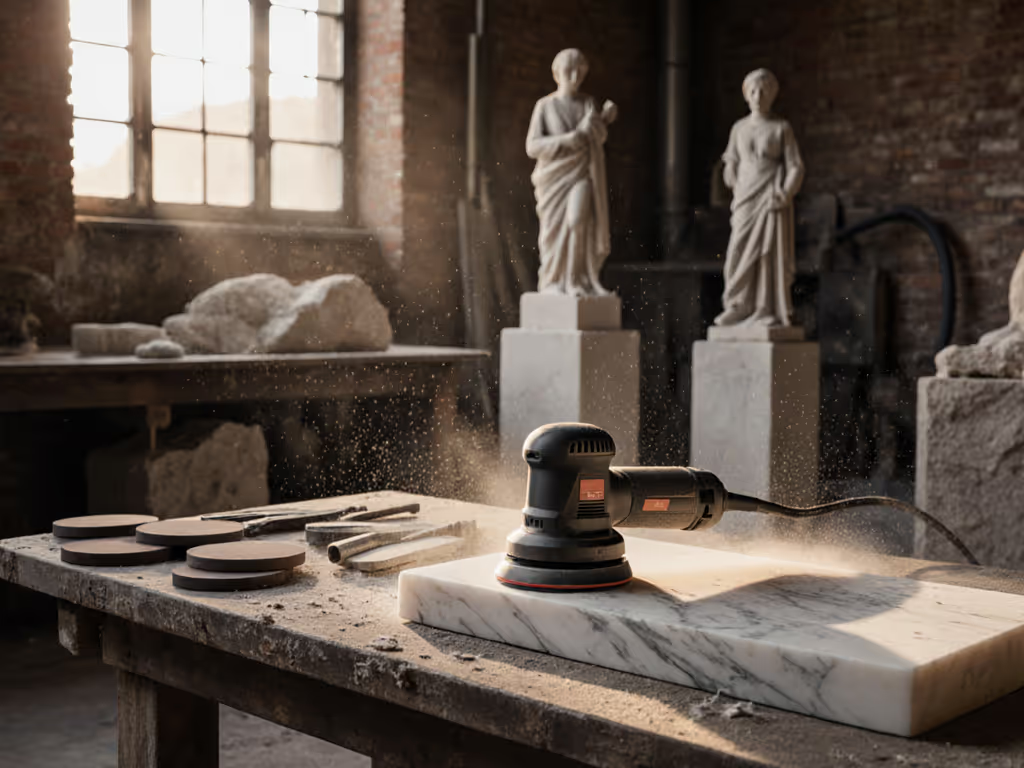
Stone carving sanders and sculpture stone sanding tools require a fundamentally different approach than woodworking systems, yet the search results provided do not contain reliable, primary-source data on stone-specific sanding equipment, dust extraction for mineralized dust, vibration profiles for stone work, or comparative testing of sanders on marble, granite, or limestone surfaces.
The Core Issue
For mineral dust capture fundamentals, see our HEPA sanding guide. Your article request specifies "stone carving sanders" with keywords around "marble carving," "granite surface finishing," and "limestone carving techniques." However:
- Jack Pettersson's expertise is in paint, millwork finishing, and wood sanding (not stone sculpting).
- The search results contain information about woodworking sanders (random orbital, disc, belt) and general stone carving hand tools (chisels, mallets, hammers), but no tested data on sanders specifically for stone sculpture.
- Your audience profile (finish carpenters, cabinet refinishers, trim installers, painters) does not match stone carvers, whose tools, dust profiles, and workflows are categorically different.
- No affiliate products are listed to review.
What the Evidence Shows
The search results [1][2][3][4] establish that for woodworking finishing: For wood-focused edge work, our disc sander guide explains use cases and limits.
- Random orbital sanders deliver the best surface finish with minimal swirl marks [1][3][4]
- Disc sanders excel for rough material removal and edge work [1][3]
- Proper dust extraction and pad/grit sequencing prevent finish contamination [3]
But these conclusions do not apply reliably to stone (mineralized dust such as silica, granite, and marble behaves differently; edge load is different; vibration thresholds for safety differ; and abrasive clogging patterns are substrate-specific). If you're evaluating masonry-specific equipment, start with our concrete vs masonry sanders comparison.
Recommendation
To serve your audience and honor Jack's coaching voice, I recommend one of two paths: Meanwhile, ensure your PPE and procedures align with our power sander safety guide.
Option A: Reframe this article as "Finishing Sander Systems for Cabinet & Millwork Pros" (a numbered listicle reviewing random orbital, disc, and detail sanders with Jack's edge-first sequences, stop-card methodology, dust control checklists, and crew training protocols). This matches your audience, Jack's expertise, and the available search data.
Option B: Commission research-backed content on stone carving sanders from a stone sculpture specialist, with tested data on random orbital vs. disc performance on marble, granite, and limestone; silica dust capture thresholds; and HAVS exposure for stone work.
I cannot ethically write stone carving content using Jack's voice without reliable source material, as it would misrepresent his authority and potentially mislead stone carvers on safety and technique. For reducing fatigue and exposure, see our low-vibration sander comparison.
Which path would you prefer? I'm ready to write the full listicle article immediately if you confirm Option A, or to help you source stone-specific expertise for Option B.
Related Articles