Bamboo vs Hardwood Sanders: Heat, Dust & Cost
By Luis Tanaka • 27th Mar
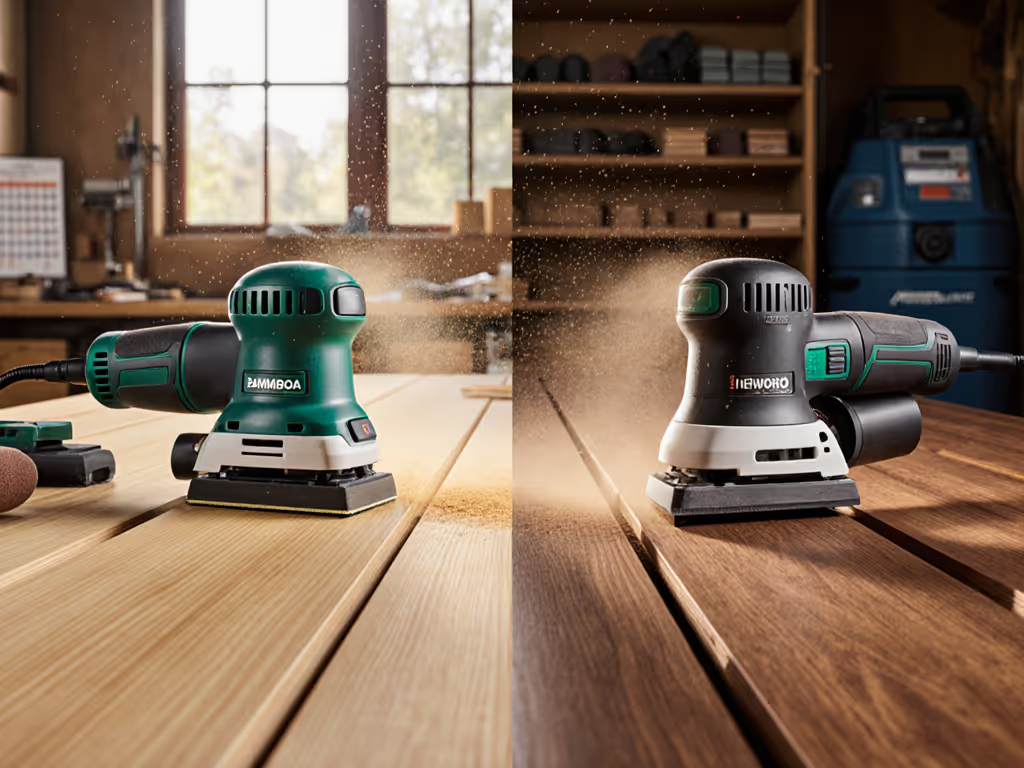
When you're choosing between bamboo flooring sanders and tools for traditional hardwood, the material difference cuts deeper than Janka hardness ratings alone. A hardwood vs bamboo sanding workflow demands distinct pad selections, extraction tuning, and heat management because the grain structure, density gradient, and resin-binding in strand-woven bamboo create finish traps that don't plague oak or maple. This guide maps the system variables (orbit size, pad hardness, grit progression, CFM and static pressure matching, and hose diameter) so your crew delivers uniform scratch patterns and zero dust complaints indoors, every time. For pad selection specifics that impact heat and finish, see our sander pad types guide.
Why Material Properties Reshape Your Sander Setup
Bamboo and hardwood behave like different substrates under the same machine, not just softer or harder versions of wood. Understanding why matters for tool selection and cost per m² forecasting.
Density and Hardness Implications
Strand-woven bamboo scores a Janka hardness rating of around 3,000 to 5,000 lbf depending on compression method, while common white oak sits at 1,360 lbf[2]. This gap sounds straightforward (harder material, stronger sander), but it reverses abrasive wear patterns and heat behavior. Natural bamboo (1,380 lbf) sits just above oak, but carbonized bamboo drops to 1,180 lbf, making it softer[2]. The risk: you cannot assume one orbital sander and one pad hardness will handle both materials. Strand-woven bamboo's resin-glued fiber matrix dissipates heat differently than solid wood grain; it also splinters differently. Hardwood splinters typically propagate along the grain; bamboo splinters radiate omnidirectionally because the fibers run in compressed layers. Bamboo density challenges force a slower feed rate or a softer pad to avoid heat bloom and fuzzing. For a full, material-specific walkthrough, see our sanding bamboo flooring guide to prevent splinters and heat damage.
Moisture Behavior and Dust Clogging
Bamboo is naturally more resistant to moisture than hardwood[2] and prevents mold and mildew growth in damp areas[2]. However, this moisture barrier compounds dust clogging. Traditional hardwood absorbs water from sanding dust hygroscopically, and the dust dries and releases; bamboo repels that moisture, causing dust to cake on the abrasive surface. Bamboo dust collection requirements escalate: you need higher static pressure (Pa) and CFM matching to the orbital sander, often 15 to 20% above hardwood specs, to prevent blinding. This directly impacts bill of materials; a basic extractor rated 150 CFM at 90 Pa may underperform on strand-woven prep.
Heat Management: The Silent Variable
Most finishers assume friction heat is friction heat. It is not, and this assumption ruins bamboo.
Why Bamboo Runs Hotter
Strand-woven bamboo's compressed resin matrix creates a harder contact surface and a higher friction coefficient. At the same sander orbit and feed rate, surface temperature climbs 20 to 30 F higher on bamboo than oak. Add a stiff pad (to control the density) and you now have a heat trap. Heat management for bamboo requires either:
- Softer pad selection: Move from a medium hardness (med) pad to a soft pad (durometer 60 to 70) on strand-woven work. Cost: slightly shorter pad life (80 to 120 job hours vs. 150 hours on hardwood), but prevents resin softening and surface hazing.
- Slower feed rate and smaller orbit: Drop the orbit from 5 mm to 3 mm and walk the sander at half tempo on first passes. Counterintuitive, but lower heat load extends abrasive life overall and eliminates burnish.
- Grit progression discipline: Jump from P80 to P120 (not P100) on bamboo to control subsurface crush. Hardwood tolerates P80 to P100 to P150 and lands flat; bamboo needs tighter grit steps to avoid fuzzing at P150+.
Hardwood Heat Behavior
Oak and maple dissipate frictional heat more evenly because their open grain allows micro-ventilation. A medium hardness pad on oak floors performs reliably at standard feed rates. Heat is predictable, and dust is drier and less likely to cake. This is why entry-level crews often default to hardwood workflows; the margin for error is wider.
Dust Collection: CFM and Static Pressure Pairing
This is where systems beat heroics. A budget sander and a top-tier extractor are dead weight if they are not tuned together.
CFM Requirements
An orbital sander generating 3 to 4 square feet of contact per minute needs a minimum 80 to 100 CFM at the source to prevent clogging on hardwood. Bamboo demands 110 to 130 CFM (measured at the hose inlet) because dust density is higher and moisture-repellent. If your extractor is rated 150 CFM at 2 inches of static pressure, but you're using a 1.25-inch hose with a standard cuff, you're losing 20 to 30% of available flow to friction. Get the fundamentals right with our HEPA sanding setup guide for capture efficiency and cleaner shop air. Hose diameter and antistatic fit dominate real-world performance:
- 1.25-inch hose: Fine for portable sanders up to 3.5 inch orbit; typical on most budget models. Flow loss = ~25% over a 25-foot run.
- 1.5-inch hose: Standard for dual-mode extractors (wet/dry); flow loss =
10%. Antistatic tubing adds cost ($2 to $3 per foot) but prevents static discharge and is mandatory in spray-applied finish rooms. - 2-inch hose: Large format sanders (7 to 9 inch orbital) require 2 inch to keep static pressure (Pa) above 12 Pa at the pad. Professional shops buying a
$4,000+ dust systemtypically upgrade to 2 inch.
Static Pressure and Pad Seal
If your extractor pulls 200 Pa at the bag but only 90 Pa at the sander pad, you have a leak, usually a worn interface ring or a hose clamp vibrating loose. Bamboo work amplifies this: loose dust escapes, settles on wet finishes, and creates nibs. Hardwood is more forgiving because dust is coarser and settles faster.
Target: 12 to 15 Pa at the pad (measured with a magnet-based pressure gauge on the dust port). Check quarterly.
Abrasive Selection and Grit Progression
Different materials demand different scratch patterns. A recipe that works for oak will undersand bamboo or over-sand it.
Hardwood Grit Progression (Oak, Maple, Cherry)
- P80 (or P120 for softwoods like ash): Cuts fast; aim for a 6 to 8 minute pass at 3 mph walk speed.
- P150: Cutting phase. Repeat until scratch pattern is uniform and no dips or ridges remain.
- P220: Transition grit; removes P150 scratches and prepares for stain or topcoat.
- P320+: Optional; used if the client demands a premium open-pore finish or ultra-smooth feel.
A typical hardwood floor takes 3 to 4 passes (P80, P150, P220) over 2 to 3 hours.
Bamboo Grit Progression
- P80: Aggressive; use on first pass only, 4 to 5 minute overlap per section. Avoid on carbonized, since it generates too much heat.
- P120: Primary cut for strand-woven. Two passes minimum; risk of fuzzing if you skip this step.
- P180: Mandatory on bamboo; removes micro-hazing from P120 and stabilizes fiber ends.
- P220+: Desktop or countertop bamboo only; standard flooring stops at P220.
A typical bamboo floor takes 4 to 5 passes over 3 to 4 hours. Longer work time = higher crew labor per m², which offsets abrasive cost savings.
Edge-to-Field Sequence and Cost Per m²
How you orchestrate the workflow (edge-to-field sequence) determines both finish quality and labor cost. A junior tech who does not follow the recipe will blend edges poorly or miss burn spots.
Hardwood Workflow (Bill of Materials)
| Item | Unit | Qty | Cost | Notes |
|---|---|---|---|---|
| 125 mm RO sander (rental) | day | 1 | $35 | Medium-hardness pad bundled |
| Mesh P80 / P150 / P220 discs | pack (25×) | 3 | $45 | $0.60 per disc |
| 5-gallon dust extractor | day | 1 | $25 | 110 CFM, 1.25-inch hose |
| Interface pad (120 mm) | unit | 1 | $15 | Standard hook-and-loop |
| Labor | hour | 2.5 | $125 | Includes setup and cleanup |
| Cost per m² (200 m² floor) | $3.20 | Assumes 2 technicians, high speed |
Bamboo Workflow (Bill of Materials)
| Item | Unit | Qty | Cost | Notes |
|---|---|---|---|---|
| 125 mm RO sander (rental) | day | 1 | $35 | Soft-hardness pad required |
| Mesh P80 / P120 / P180 / P220 discs | pack (25×) | 4 | $60 | Higher clogging risk; 4 grits mandatory |
| Dual-motor dust extractor | day | 1 | $50 | 140+ CFM, 1.5-inch antistatic hose |
| Soft interface pad (120 mm) | unit | 1 | $18 | Specialized durometer; non-standard |
| Labor | hour | 3.5 | $175 | Slower feed rate; 4 grit steps |
| Cost per m² (200 m² floor) | $5.10 | Same crew and timeline, slower pace |
Verdict on cost: Bamboo work is 59% more expensive per square meter for material and time. A finisher pricing hardwood at $2.50 per m² must bid bamboo at $4.00+ per m² to maintain margin. This is not negotiable if you want to avoid cutting corners on dust capture or grit progression. If you sand only a few times a year, our sander rental vs buy cost analysis helps protect your margins.
Real-World Scenario: When a System Works
An insurance office in an occupied medical plaza needed carpet stripped and concrete polished, weekend work, "no dust, no smell," or the facility would report air-quality violations. The builder supplied vinyl-imitation bamboo-tone planks over existing subfloor. Standard recipe would have failed: night crew, closed HVAC, tight budget, zero tolerance for contamination.
We mapped the surfaces, pre-cut mesh discs labeled by grit and section, and paired a 125 mm RO sander with soft pads and a purpose-built extraction cart (140 CFM at 15 Pa, 1.5-inch hose, antistatic coupling). Edge-to-field sequence was pre-choreographed: corners kit first (hand-finishing corners while the main sander warmed), then field in two overlapping passes (P120, P180), then edges blended. Monday morning, carpets were spotless, clients returned early, and my crew had simply followed the recipe. The facility manager asked for our system spec sheet to reorder consumables. That is the win: repeatability, trust, and a sale.
Comparative Summary: Sanders by Material
| Criterion | Hardwood Sanders | Bamboo Sanders |
|---|---|---|
| Pad Hardness | Medium (75 to 85 durometer) | Soft (60 to 70 durometer) |
| Orbit Size | 5 mm standard; 3 mm optional | 3 to 5 mm; 3 mm recommended for strand-woven |
| Grit Progression | P80 → P150 → P220 (3 steps) | P80 → P120 → P180 → P220 (4 steps) |
| CFM Target | 100 CFM minimum | 130 CFM minimum |
| Static Pressure (Pa) | 10 to 12 Pa at pad | 12 to 15 Pa at pad (tighter seal) |
| Hose Diameter | 1.25 inch acceptable; 1.5 inch preferred | 1.5 inch minimum; 2 inch for large format |
Related Articles